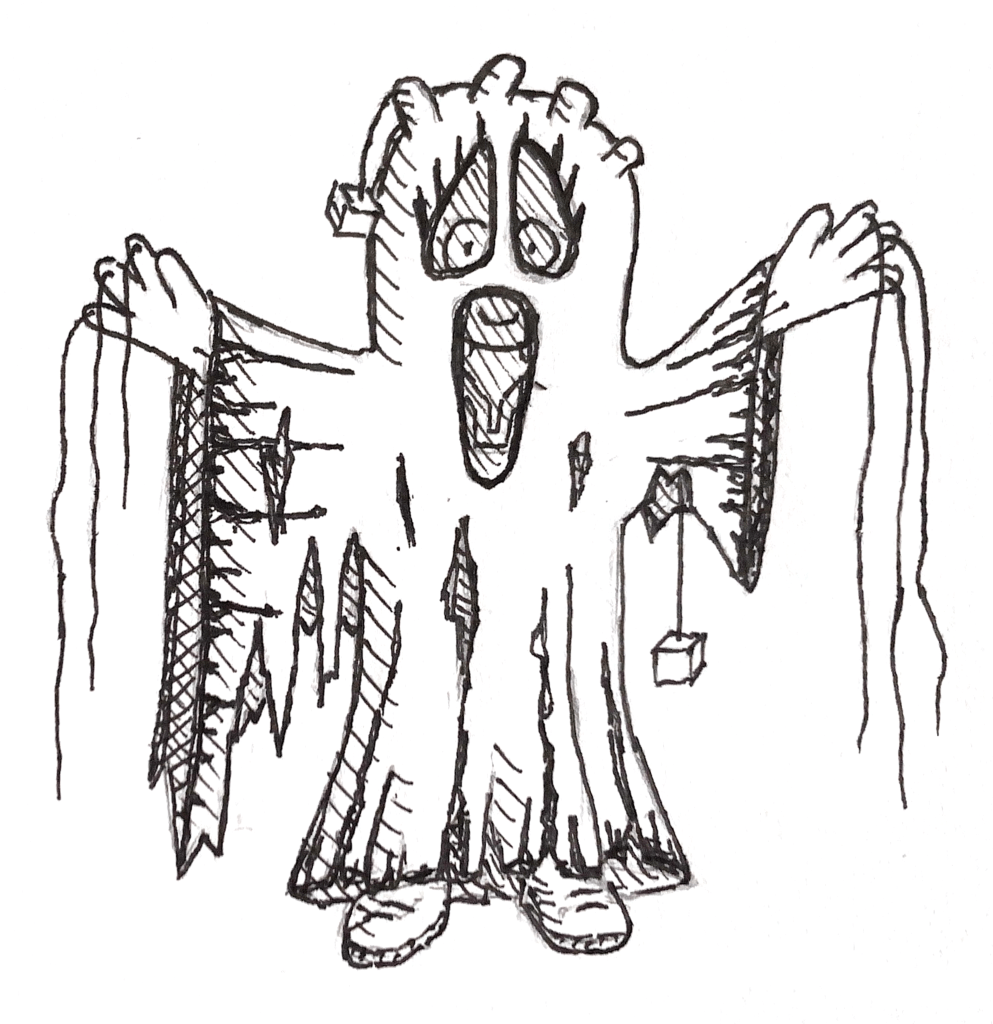
Fleepa was a Chutter who worked in the kitchen of Gardragit’s castle. She was not a chef– no, nothing so respectable as that. Nor was she a royal server, presenting exquisite meals to delighted natha with studied cordiality. Nor was she a meal-curator, assessing hungry natha and identifying the precise dishes and course order which would appeal most to their individual temperaments. No, Fleepa was a dish-washer, and there is no glory in that.
She spent her working hours with wet hands and a sweaty brow, handling culinary refuse and scrubbing delicately wrought dinnerware– for the dishmakers of Chut were a talented group, revered all over the world for plates and bowls that were nearly as beautiful as the meals they held.
One day, while conversing with her friends at Laer Pond, the conversation turned to work. And her friends spoke of their respective jobs, saying such things as, “That song of mine is so popular that I scarcely get a chance to sing anything else;” or, “My interior design skills are so desired that I scarcely find myself without multiple projects;” or, “My dance students are so graceful that I scarcely have to drill them at all.” And when they asked Fleepa about her job she said, “I have little to say on that matter.”
One friend said, “Yes, I too was a dish-washer once, for a couple of weeks; I did not much relish it.” Fleepa had been a dish-washer for two hundred years. “But if you truly work for it, you shall one day attain your career goals, as we have. Tell us, what is it that you would most like to do?”
And Fleepa was silent for a moment, for what she wanted most was, in her estimation, a silly thing. But they pressed her until she eventually admitted, “I would design dresses for our ruler Gardragit.”
At this all her friends were silent, for Gardragit wore only the most spectacular dresses conceivable by natha or Borgokog. Only the most brilliant seamstresses in Chut held the honor of designing her dresses, and then only when Gardragit deigned to wear something she had not designed herself. “But I do not really expect to attain that,” Fleepa added when the silence had become unbearable.
“It is a lofty aspiration,” said one friend.
“It is good to want great things,” said another. But they made no further comments on the matter, and instead changed the subject as tactfully as they could manage.
When Fleepa went home, she worked at sewing a lovely dress of her own design. She had sewn many dresses in her time, though few of them ever saw the world outside her room, for they were uniquely extravagant, or singularly peculiar, or otherwise at odds with Chutter fashion at the time, and were therefore inappropriate even for festivals. For Fleepa did not design the dresses to suit a mere natha, but to adorn a Borgokog. And this was partly why her friends were so startled by her aspiration: they had never seen her dresses. But she worked nonetheless, for she hoped to one day show her designs to Gardragit.
She did not know how to bring about such a circumstance, however. She did not even know who currently designed dresses for Gardragit– for that natha wished to remain anonymous and thereby avoid clothing requests from their friends. Fleepa had often imagined wearing one of her own dresses to a festival, but balked at the notion of appearing so indecorously eccentric at a public event, even though Gardragit might see her work then. And she knew Gardragit would not give audience to some mere natha with no serious business, for Gadragit was busy ruling the domain. Fleepa fell asleep thinking this, with her head on the incomplete dress.
The next day she worked not at the castle kitchen, but at the playhouse kitchen, for there was a play that evening performed by the Simpaddul Players, which at the time was the most famous theatre troupe in the world. A grand feast was to be held immediately following the production, with snacks and drinks during the intermission, so Fleepa had to wash dishes continuously after the second act. But that allowed her to watch the start of the play, and it was then that she marveled and laughed at the extravagance of the actors’ costumes. “How silly they look,” she thought. “Such outfits are utterly unfit for polite society.” And then she laughed, though no joke had been spoken.
As she washed dishes during the intermission she ruminated on these costumes, and it was then that a plan came to her. “If I can join the Simpaddul Players,” she thought, “then I can costume the actors in my own dresses, and thereby display them to Gardragit.” For the Borgokog had been in the audience, as she often was.
But Fleepa was stuck washing dishes for the rest of the evening, so she did not have a chance to speak with the theatre troupe then.
It was not until the following day that Fleepa spoke to the troupe. She approached them before rehearsal at their playhouse, and after the requisite introductory rituals she said, “Who is the director here?”
And the famous Jroopan stepped forward and said, “I am.” And Fleepa should have known this.
So Fleepa asked to join the troupe and design their costumes. Now you may think that it was no easy feat to join that famous troupe, but in fact they did not have a costume designer then, for the actors wore their own clothes, or costumes borrowed from other domains. So Jroopan welcomed Fleepa into the troupe.
The next play they produced was another farce, so all the costumes were absurd and ugly, and therefore unfit for a beautiful Borgokog. But Fleepa designed them anyway, thinking, “The next play will afford me an opportunity to display my ability to Gardragit.” Then the play went up, and everyone laughed at the ridiculous costumes.
The next play was a drama set in Tuubuut. The costumes were naturally crude and plain, for that was the fashion of Tuubuut. But Fleepa designed them anyway, thinking, “Surely the next play will feature a lovely Borgokog character.” And the play went up, and everyone marveled at how authentic the costumes were, though none of them had in fact seen a Tuubuutite before, and neither had Fleepa.
The next play was a history of Chut. “At last!” thought Fleepa. “I will have the opportunity to design a dress appropriate for Gardragit herself.” And so she spent many nights designing and deliberating and redesigning, for she wanted this costume to be the best she had ever made.
And when she brought the dress to rehearsal and the actor playing Gardragit wore it, the director said, “What is this? I have never seen good Gardragit garbed in such strange attire.”
“I have taken some artistic liberties,” said Fleepa.
“It would be better if you had not,” said Jroopan. “Go home tonight and make a dress more fitting for Gardragit.”
“But do you not think the character of Gardragit should wear a costume so unique and daring that all who witness it gasp and marvel at its otherworldliness?” said Fleepa.
“No,” said Jroopan. And he was the director, so Fleepa acquiesced.
That night she designed a dress very similar to one she had seen Gardragit wear at a festival. And when Jroopan saw it he was pleased, and declared that the actor would wear it.
But Fleepa wept all that night, thinking, “This is my chance to demonstrate my singular artistic vision to Gardragit, and it is squandered.” And she decided then that she could not give up her dream.
Fleepa said no more on the matter for the remainder of the rehearsals, during which the actor wore the redesigned dress. But on the night before the opening performance, when she took the costumes home to wash them, she did not wash the designated Gardragit costume. Instead she destroyed it.
So the next night, after spending the day washing dishes at the castle, Fleepa went to the Simpaddul Playhouse with her original rejected Gardragit costume. She approached the actor in her dressing room, and handing her the costume said, “There has been a costume change.”
“But I have not rehearsed in these clothes,” said the actor.
“Nevertheless you shall perform in them,” said Fleepa, and she left marveling that an actor should be so particular about her stage clothes.
And when Fleepa sat amongst the audience she trembled at the thought of what she had done. For all her life she had never disobeyed a superior’s order. “I shall lose this theatre job,” she fretted, “and thereby lose my only chance to attract Gardragit’s attention.” But her machination was already in place, and anyway she still had hope that the ploy would succeed.
Then Gardragit, the Borgokog herself, entered the theatre, and all the natha inhaled in admiration, and Gardragit sat in the center of the front row, as was customary, and all the natha exhaled with pride. And the glory of Gardragit calmed Fleepa. From her vantage at the far right she could see the beautiful Borgokog clearly, and thereby gauge her reaction to the play. “Even if I am fired,” thought Fleepa, ”Gardragit will surely employ me.” And she quivered with hope at the thought.
Then the lights were snuffed and the play began, and Fleepa clenched the arms of her chair until her hands were sweaty and her knuckles were white. For Gardragit’s character did not appear until the second act, and there was ample time for Fleepa to dread that moment.
Then the second act began, and the actor playing Gardragit walked onto the stage in exotic splendor, her shoulders draped with twirling azure ribbons and her figure wrapped in a spectacular dress which evoked water flowing through a forest– for Gardragit had great affection for the Thelethy Forest, and Fleepa had incorporated this into her design. And when Gardragit saw the actor portraying her she smiled. It was a smile you would have dreamt of for the rest of your life had you but glimpsed it, and it was a smile that made Fleepa’s little natha heart beat like a vingum’s scampering. But of course Gardragit made no comment then, for she held a deep reverence for theatre and all arts. And Fleepa must endure the rest of the play before she had an opportunity to speak with Gardragit.
During the intermission Jroopan accosted Fleepa and rubbed his shins in the Chutter display of anger and said, “Why have you disobeyed me and dressed our lead actor in that abomination? I have lost all the credibility I worked my entire career to attain.”
“Contrarily, your credibility has been wondrously improved this night, for great Gardragit herself was delighted by the very costume you denounce,” Fleepa would have said, if she had been afforded time to concoct a response. But at that moment all she said was, “I am sorry.” And she bowed her head and rubbed behind her ear in the traditional Chutter gesture of contrition.
“Leave this theatre,” hissed Jroopan, “and never return!” And Fleepa was so unnerved by his anger that she obeyed without another word. But she remained directly outside the playhouse, for she wished to speak with Gardragit when the Borgokog emerged. And she paced outside for a long time, while the sky turned from blue to orange to purple to dark, for it was a very long play.
When the play was over the natha poured out of the playhouse, speaking animatedly about what they had just seen, trying to impress their friends with their interpretations and criticisms and praises.
And then Gardragit herself emerged surrounded by natha who wanted to know which parts of her life the play had inaccurately portrayed. Fleepa approached this group and tried feebly to incorporate herself thereinto, but even when she clucked politely and circled her fingers around each other they did not acknowledge her, and this was very rude, and she was very offended. But she recognized that they were distracted by the presence of the loveliest Borgokog in all the world, so she later forgave them.
It was not until several minutes later, when most of the natha had retired to their homes, that Fleepa managed to speak to the Borgokog Gardragit. At that time Gardragit was heading back to her castle, so Fleepa felt apprehensive intercepting her, but this was the opportunity she had so recklessly striven towards, and she would not abandon it now. So she approached the Borgokog and reached toward the sky in deference, as was proper, and Gardragit smiled an exasperated smile and said, “Speak, my natha.”
And Fleepa said, “Good Gardragit, I am honored by your presence. Thank you for attending this play. I designed the costumes; I dearly hope they satisfied you.” She had practiced this speech in the preceding hours.
“Ah, the costumes,” said Gardragit. “Yes, they were lovely. I look forward to the costumes in your next play.” And then Gardragit left.
Fleepa, however, remained. She stood staring in the dark, watching the Borgokog depart and disappear into her castle; and if anyone had seen Fleepa they would have found her stillness unsettling and unseemly. But now she cared nothing for her appearance. Gardragit had not condemned her work, it was true; but neither had she greatly praised it. There was no enthusiasm in her response; certainly no offer of royal employment. And despite her courteous words, Gardragit would see no more theatre costumes from the disgraced Fleepa.
So Fleepa stood outside all night pondering her failure, and returned without sleeping to her dishwashing job the next morning.
That evening she spoke with her friends again at the lake. When she mentioned that she had designed the play’s costumes, her friends said such things as, “They were fine costumes indeed,” and “You certainly captured the period,” and “I’m glad you have taken a step toward your dream.” And then they turned the conversation to other matters.
In the following days Fleepa mourned the loss of her dream, and spent many kitchen shifts weeping silently until her face was as wet as her hands while she washed endless dishes sullied by happier people. And she thought that she was not as brilliant a costume designer as she had previously believed, for any reaction would have been better than that which her work had received; at least revulsion would have indicated an audacity in her designs which the audience’s milquetoast response left no room for. “It is the cruelest fate possible,” she thought, “to realize that one possesses no great ability in the sole endeavor which rouses one’s passion.”
But her depression did not last forever. Eventually she thought up a new scheme: though Gardragit’s affection was beyond her present ability, maybe the natha of some lesser domain would admire Fleepa’s work– perhaps the crude Tuubuutites. Surely even a mediocre seamstress could impress their brutish nature. And then, when she had earned renown in a lesser domain, she might attract the attention of Plüche, ruler of Boofofgth, who might then wear her designs in the presence of Feyjiji, ruler of Thelethy– and if Fleepa could impress Feyjiji, she would certainly earn Gardragit’s favor, for Gardragit held Feyjiji in high esteem. So Fleepa resolved to travel first to Tuubuut. There she would hone her skills, and begin her great journey in Borgokog fashion.
Yet there remained the obvious problem of the specters which roamed the Desolation outside Chut. These, she knew, would eat her soul if she dared to venture forth alone. And this was an obstacle which stymied Fleepa for many days. But one night as she sat at an unfinished dress she was struck by inspiration: for the dress was so pale and billowy that it seemed to have no form at all, only an amorphous and shifting presence as it danced in the wind from the window; and Fleepa likened it to a ghostly figure.
Then she thought, “Ah! I shall design a specter costume so the evil creatures will mistake me for one of their kind, and I shall thereby traverse the Desolation unharmed.”
And so Fleepa worked tirelessly to design a ghastly costume which transformed her into a hideous thing. And you would have trembled to look upon her in that attire. When she had completed the costume she said, “This is the finest garment I ever made.”
So Fleepa carried the specter costume that night as she passed through the gates of Chut. “Ho! Where do you go so curiously encumbered?” asked the guard at the gate.
“I go forth with embittered optimism and redoubled resolve,” said Fleepa. This did not answer the guard’s question, but it was spoken with such conviction that the guard felt he rightly had no authority over this brave natha.
And so Fleepa passed beyond the lovely gates of Chut, donned the specter costume, and traveled toward Tuubuut with her fabrics and needles bundled beneath her spooky robe.
Now it happened that the specters did indeed come upon her. They appeared but an hour after her departure, when Chut was just a vague spot on the dusty horizon behind her. And the world grew hazy with their arrival, and all sounds of wind and sand became painfully tangible, as if they were claws assailing her ears and her brain. And then she saw the specters, those grim terrors whose empty features seemed vast enough to contain every nightmare ever endured by natha or Borgokog. And staring into the macabre voids of their eyes as they encircled her, Fleepa realized with horror that they bore little resemblance to the costume she presently wore. And it would not have mattered even if they did, for they smelled her natha soul, and they hungered for it. Thus the specters descended upon her and suctioned their mouths to her eyes and sucked out her soul. So Fleepa met her gruesome demise alone in the Desolation in a ridiculous costume of her own design.
 Gibbering Taylor
Leave a comment