Listen now to this tale of Tuubuut.
After a raid the Ridge-Riders rested in the mountains, eating the stolen murstur-fruit and painting themselves with their cores. Only Ekkle-rog was unadorned with murstur-paint, for he had eaten none. “It is shameful to celebrate thus,” he said, “when our comrade Perz-gibbin is imprisoned by our enemies.”
“Your abstention dishonors her by denying the victory she helped us win,” said Huf-slik, who had only one eye.
“If we wished to honor Perz-gibbin we would rescue her before she is executed!” said Ekkle-rog.
“If we attempt a rescue we will die,” said Huf-slik. “We will not dishonor her by making her glorious sacrifice pointless.”
“Coward!” said Ekkle-rog. “We will not die, for we outnumber the Land-Slayers.”
“I will not undertake a mission whose risks outweigh its rewards,” said Huf-slik. “Perz-gibbin was a loyal natha, but until this night she had hardly proven her worth in battle. Her greatest gift to us was this sacrifice. I will not take that from her!” And all the other Ridge-Riders agreed.
But Ekkle-rog would not abandon his friend. So he mounted his six-legged steed Roebane and rode alone across many miles of mountains, and Roebane’s krikisi legs navigated the rocks so dexterously that Ekkle-rog could have slept throughout the ride, though he chose not to, which later proved a woeful mistake.
When he came to the Orgon Ravine he proceeded slowly, for he knew the great Ikovko sometimes lurked there. So he threw a rock into the ravine, and then he heard a monstrous shifting below. And he knew he must find another crossing to avoid that terrible monster.
But the nearest crossing was far away, and despite his exhaustion Ekkle-rog still did not sleep during the ride, for he feared he would miss his destination. But after nightfall he could not keep his eyes open, and he decided to make camp. So he tied his krikisi to a boulder and slept in an alcove.
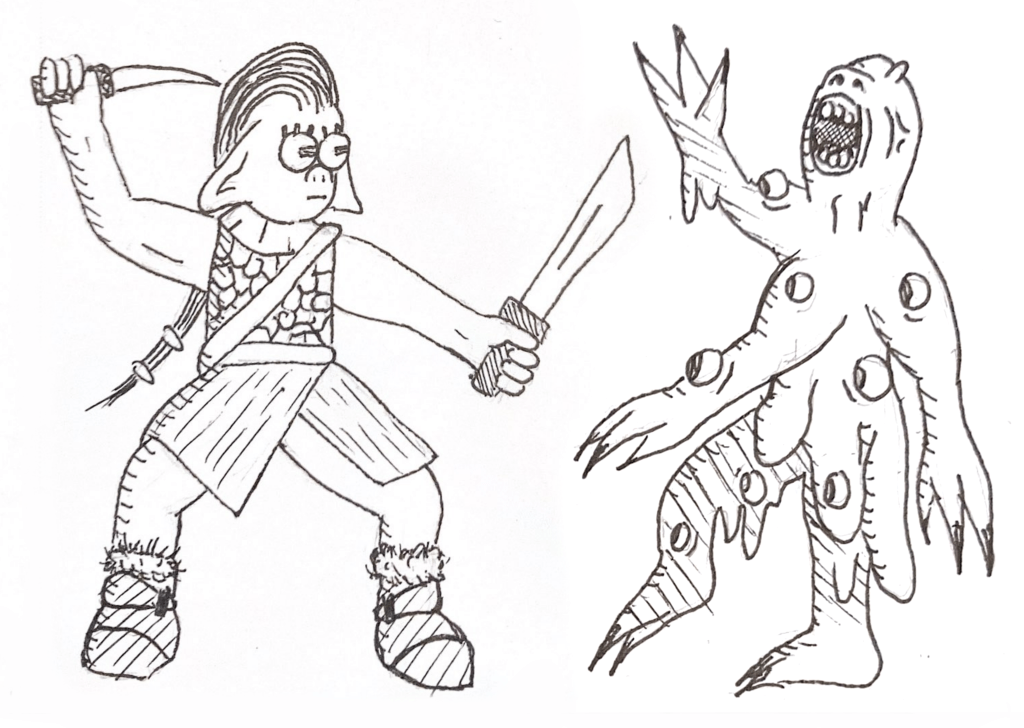
He awoke to the sound of his krikisi barking, and then he saw an awful sight: atop Roebane sat a natha whose flesh hung in long folds, and some of these held eye-balls; but the skin on their head was so tight that each vein was clearly visible, and here there were no eye-balls, only nose-holes and a skinless gaping mouth. But most disconcerting of all was the third arm which protruded from their chest. The krikisi thrashed about, but could not displace its wretched rider.
So Ekkle-rog pulled the thing from the steed. The natha howled and slashed at Ekkle-rog with one arm, but missed; and then they struck with their second arm, which Ekkle-rog also dodged; but with their third arm they clawed great wounds into Ekkle-rog’s thigh.
Then Ekkle-rog with his left blade struck at the creature, but they caught his arm; so Ekkle-rog swung his right blade at the thing’s leg, but with their second arm they caught that blow as well. Then holding both of Ekkle-rog’s arms they leapt upon him and pinned him to the ground. And with their free arm they clawed Ekkle-rog’s chest through his leather armor.
So in a mighty endeavor Ekkle-rog rolled over, so the natha was now beneath him. And with his shin he pinned one of their arms, and with both hands he pulled the pinned forearm until the bone broke through the flesh. And as the natha shrieked Ekkle-rog pushed that protruding bone into the creature’s abdomen. The natha writhed and kicked Ekkle-rog off, and the blood flowed from their belly-wound in great spurts. Then they reached into that wound and tore out a heart which had been pierced by the bone. And they squeezed their heart until it burst in a blood-spray which blinded Ekkle-rog.
Then they hissed and grappled with him, and he was soon covered in the blood which spurted from their belly, and then Ekkle-rog laughed. And then the thing also laughed. And for many moments they held each other, laughing, for neither of them had ever fought so great a duel.
Then Ekkle-rog shoved the natha off him and mounted his steed. “May I ride with you?” cried the thing.
“Where?” asked Ekkle-rog.
“Anywhere away from the arrow folk.”
“I can take you to the land folk,” said Ekkle-rog, “but you must help me kill them.”
“I shall,” said the thing.
“In that case let me fix your bone, that you may fight at your utmost,” said Ekkle-rog. So with his knife crafty Ekkle-rog sawed off the protruding arm-bone, even as the natha screamed horrifically; and then with his fingers he removed the bone-splinters from the wound; and with his water-skin he washed it; and to keep the arm in place he set an arrow against it, bound tightly with a strip of his own skirt. And he would have treated their punctured abdomen, but the natha wanted to keep that wound.
Together then they rode Roebane toward the sun rising over the mountains. As they traveled Ekkle-rog learned the natha’s name was Menk, and they had slain a Ridge-Rider from some neighboring clan, and were now hunted. Ekkle-rog asked how they became monstrous, and they laughed and said they had always been so, for they hailed from grim Vorgoftonk where the natha are all frightful. But Menk could maintain no friendships there, for no other Vorgofs shared their love for battle. So their ruler Vaka had taken them to Tuubuut. And since coming here they had fought many battles, but found no friends.
“If you seek an honorable duel,” said Ekkle-rog, “you will not get it from the Land-Slayers. We must slay them with stealth, or they will execute my friend.”
“This does not bother me,” said Menk, “for you satisfied my craving earlier.”
At noon they came to the scorched crossing. And when Ekkle-rog threw a rock into the ravine he heard no monstrous sounds, so he drove the krikisi to the bridge.
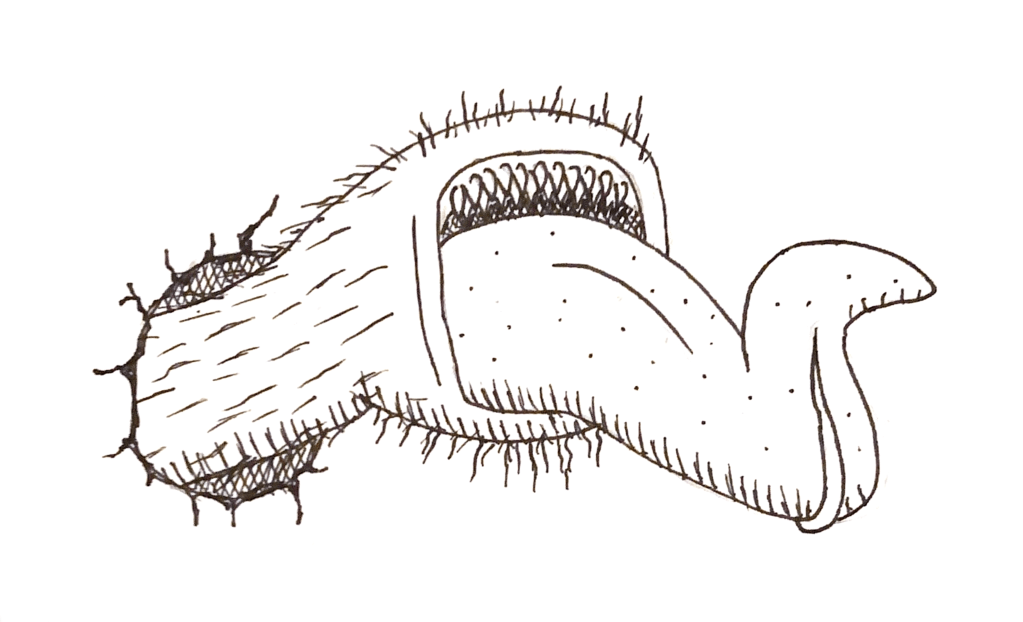
But as they approached the apex they heard a great rumbling of rock ahead, and from the far cliffside emerged a creature of horrific length whose entire head was a mouth lined with rows of sharp teeth, with a tongue which seemed too large even for that great maw. And from this maw the Ikovko unleashed a honk so loud that the krikisi Roebane scuttled backwards in terror to the edge of the bridge.
But there was no time to travel to another crossing, for Perz-gibbin might be executed any day. So Ekkle-rog dismounted, and he pulled the Vorgof Menk off the krisisi as well. “We must fight,” he said. And he drew his twin blades and waited for the beast to come within throwing range.
But Menk instead climbed back atop the krikisi, and would have ridden it away, but the frightened steed shook them off. And when Ekkle-rog saw this he said, “I shall put one blade in the Ikovko, but if you attempt another betrayal I shall put the other blade in you.”
So Menk did not pursue the krikisi further, and instead climbed up to a nearby ledge. At the edge of the ledge was a spire of rock, ancient and weathered, with great cracks near the base. And Menk approached this spire and saw Ekkle-rog below, still awaiting the monster’s move. So Menk pushed against that rock-spire in Ekkle-rog’s direction, and though the rock grated and groaned, Ekkle-rog did not hear it over the Ikovko’s dreadful honks.
Then the Ikovko whipped its weight against the bridge until it collapsed, leaving no crossing. And Ekkle-rog wailed in fury, for without this crossing it would be days before they reached Perz-gibbin, and by then she would surely be dead. And without the bridge it benefited him nothing to battle the dreadful Ikovko, so he turned to flee.
But as he turned the monster‘s thick tongue lunged out and struck Ekkle-rog to the ground. And it wrapped around him so he could not wield his weapons. Then Ekkle-rog looked into the toothy cavern of its mouth, and wondered whether he would die pierced by those fangs, or crushed by the tongue, or suffer some darker fate within its endless body.
Then the rock-spire above broke loose and fell, and that rock pierced the Ikovko’s tongue and pinned it to the ground, and with a dreadful honk the beast released the natha. Then Ekkle-rog looked up at Menk on the ledge, and Menk looked down at him. And Ekkle-rog said to Menk, “You were wise to aid me in this instance. You may continue to ride with me as long as I can tolerate you.”
So both travelers mounted Ekkle-rog’s krikisi, and since the bridge was collapsed they rode across the monster’s impaled tongue, and up the monster’s head, and along its writhing body, all the way to the tunnel in the opposite cliff face from whence it protruded, and onto the rocky ground. And they were far away when the colossus finally tore its tongue free, and that is how the Ikovko’s tongue was split.
They rode until they left the mountains, and continued over the desert plains as night fell. Eventually they saw the mud-brick wall of the Land-Slayer village, adorned with ribs. And the gate was guarded by a single natha.
The natha guarding the gate was named Yolen-weg, a socializer with a talent for making those around her feel relaxed regardless of their temperament. But now she was alone by choice, for in the days after a death she craved solitude. And in the chill air she held the spear called Desperation, which she had won from the Cave-Ripper For-wiz when she defeated him at Berderstill. She had evaded its point with a mere turn of her head, and this so impressed For-wiz that he bequeathed his spear to her after she sliced his entrails onto the ground. And he asked to be killed by his own weapon, so she retrieved it from the wounded ground and drove it into his skull through the eye. And since then Desperation had slain many natha, thrown by Yolen-weg’s unerring arm. And its inscriptions were famous among both the Land-Slayers and the Cave-Rippers, for they listed each of its victims, and covered much of the shaft. But Yolen-weg would etch no more names into that worthy weapon, for on this night Ekkle-rog hid behind a rock and with his bow shot an arrow into her neck, and she died in breathless silence.
The nearest natha was Hon-bist, but he was within the wall carving runes into a stone tablet and did not hear his comrade fall. The runes relayed the tale of their recent encounter with the Ridge-Riders, and eulogized swift Kwor-zin, who had died defending the precious murstur-fruit. Also written were the victories of his allies, with a particular emphasis on the heroic deeds of joyous Yolen-weg, for it was to her Hon-bist owed his place in their village: he had been banished from Bestholde for cowardice at the Battle of Veng, and his named ruined amongst all the Land-Slayers; but Yolen-weg had convinced her clan to take him in. “For a natha with something to prove is a great ally,” she had said, ignoring the furious protestations of her comrade Jete-nen. And Hon-bist had indeed proven himself yesterday when he wounded the Ridge-Rider who would otherwise have slain that comrade. So after Jete-nen took that natha prisoner she told Hon-bist, “I was wrong about you. Take my tooth.” And she had given him her regglezoth fang necklace. So Hon-bist was wearing that tooth as he wrote the runes. And he was grabbed around the neck by two mighty legs, and one of the feet gripped the fang on the necklace with its toes, and stabbed the fang into Hon-bist’s neck five times, and each time the blood spurted out but he could not cry out. So Hon-bist died in the Vorgof Menk’s legs.
Jete-nen, whose tooth killed Hon-bist, was inside her house when this happened. This was her guard-night, but after Kwor-zin’s death their clan had ordained that Jete-nen skip the watch for three days. And during this time she had spoken to each of them of Kwor-zin, but had told no one of her great anger at that natha. For if Kwor-zin had not attacked the Ridge-Riders alone she would not have died. And now Jete-nen heard more sounds of violence outside, so she went to her window and saw her new friend Hon-bist being attacked by a monstrous thing, its loathsomely long legs taking his life. So she drew her dagger to save good Hon-bist as he had saved her. But she did not throw the dagger, for her wrist was impaled by an arrow which pinned it to the window frame, and the blade fell from her hand. Then she cried out in pain until another arrow pierced her forehead and tore her brain.
Jete-nen’s death-cry was heard by Num-syte and Verg-lur in the krikisi stable, and by Kar-kadgen in the armory. Kar-kadgen was holding the armor their prisoner had worn, as he had been doing for many hours. For it was a breastplate of bronze, inscribed with images of natha and beasts its wearer had known and fought. And Kar-kadgen knew the names of all these natha and beasts, and their stories, for the prisoner Perz-gibbin had told them all. And Kar-kadgen had promised Perz-gibbin that he would remember these stories after her execution. So he was admiring the armor of their dead prisoner when he heard Jete-nen cry out, and he donned the prisoner’s breastplate and grabbed his own spear and left the armory to defend his friends. But a fearsome creature leapt upon him from above, and grabbed the spear from his hands, and thrust it into his collar-bone and out his buttock, and so Kar-kadgen died.
Meanwhile, Num-syte and Verg-lur in the krikisi stable looked to the one krikisi that had survived the raid, and Num-syte said to Verg-lur, “Take the krikisi. You are the better rider.” And Verg-lur knew this was true, though to leave his friend steedless was to ensure her demise. Nevertheless he mounted that steed, whose name was Faranix, and whose saddle was dyed red as blood, and he rode out and saw the corpse of Kar-kadgen. Then he cursed Yolen-weg for failing to guard their village, as he had expected she someday would, and that was the last thing he did before an arrow pierced his skull and he fell dead from Faranix.
Then from the stable noble Num-syte called out, “If you are warriors then show yourselves and fight gloriously! Though you slay my beloved kin, you earn no honor with cowardly tricks. All those you killed tonight are greater than you, for they fought! So if you are not afraid, come to the stable. I await you.”
And then in the doorway she saw a dreadful thing drenched in blood and riddled with eye-balls. So she threw her spear, but the creature caught it and broke the shaft. Then the thing walked toward her unarmed, so Num-syte knew she should drop her own knife. But in the presence of so gruesome a foe her courage failed, and she threw the knife and pierced an eye-ball in the thing’s chest. But the thing only hissed without stopping. So Num-syte fell to her knees and cried, “Spare me, and you shall have all the wealth of my clan.”
“I shall have it either way,” said the natha. And then another natha appeared in the doorway, this one a Tuubuutite, and Num-syte recognized her enemy Ekkle-rog. “Where is my friend Perz-gibbin?” he asked. And Num-syte herself had slain that natha this very day, but she dared not say so. Instead she said, “Your ally is in the armory.”
“Take me there,” said Ekkle-rog.
“Let me leave,” said Num-syte, “and I will never trouble you again. You have slain my people. You have defeated me. I am nothing now, unworthy of your attention.”
“Indeed you are not,” said Ekkle-rog, “but you shall have it nonetheless. Take me to my friend or die in the dung of your steed.” And Num-syte dared not disobey, and hoped to find a chance to escape before the Ridge-Rider saw his dead friend. So they left the stable with Ekkle-rog on the right and Menk on the left, and always Menk kept a clawed hand on the back of Num-syte’s neck. And as they passed the bloody corpses of her kin she found no opportunity for escape. And when they came to the armory she knew she would have no more chances, but still she did not flee.
And when Ekkle-rog saw Perz-gibbin dead and stripped of her armor he did not cry out and fall to his knees, as Num-syte had hoped. Only Menk moved. They leapt up and clasped their legs around Num-syte and brought her to the ground. Then the grappled Num-syte watched Ekkle-rog approach his slain friend. And crafty Ekkle-rog drew his knife and held it against his friend’s lifeless face, which was still warm; and he sliced a circle around it, then peeled the face off and placed it over his own. Then he returned to noble Num-syte and thrust the knife into her chest with such force that it shattered her ribcage. And Ekkle-rog reached into the wound and tore out her heart and crushed it, so Num-syte died looking at the face of the natha she killed.
 Gibbering Taylor
Leave a comment