During the week before Gerving’s Deftlus Festival, Sir Murtina and his brother Morga played at swords. Morga was a good duelist, but had not yet proven himself in any great battles or quests, and was accordingly not a knight. “But at the Deftlus Festival,” said Sir Murtina between parries, “you will compete in the duels. And if you fight as I have trained you this past year, then you will earn victory, and knighthood. And then I shall knight you myself.” And Sir Murtina hoped this was true, for he could not bear to see his brother disappointed again; he already felt guilty for his own knighthood while his brother remained honorless.
So they dueled all afternoon, and when evening came Sir Murtina’s squire removed their armor and laid out the dinner she had prepared for them, and they ate well and drank merrily. And then Morga seemed optimistic.
But the next day Morga fell ill, such that he might not rise from bed, and would eat nothing, nor drink aught but warm milk. So Sir Murtina was sore aggrieved, and neglected his knightly duties that he might stay by his brother’s side. And he sent his squire to fetch a doctor.
But when the squire returned, she was alone. “The doctors are all busy with the similarly afflicted,” she said.
“How many suffer from this mysterious malady?” asked Sir Murtina.
“Many, though the doctors can neither identify nor treat it,” said the squire.
As the day passed Morga became weaker, and his complexion faded to a sickly grey, and his once-strong muscles atrophied. And though a doctor was eventually available to see him, no treatments were successful. “It is a curse upon us,” said the doctor. “We need not medicine, but magic.”
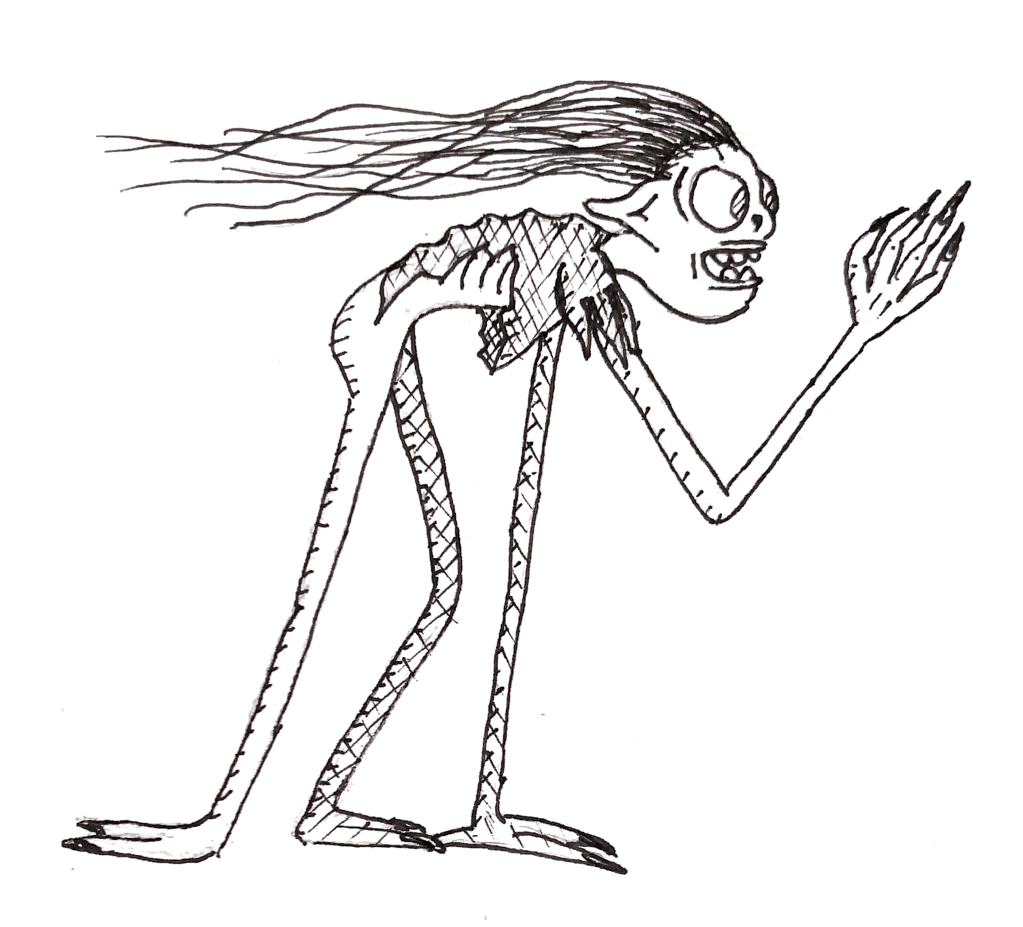
Then evening came, and Sir Murtina saw his brother’s limbs elongate, and saw his hair grow coarse and red as blood, though before it had been blond. And whenever he managed to speak, which was seldom, his voice was high like a child’s, though before it had been deep.
So the squire consulted the witch Elgro in her hut outside of town. And in the candlelit room, under a canopy of bones dangling from the ceiling, the witch said to the squire, “The master of the curse lives in the mire of plague.”
And so the squire returned to Sir Murtina to relay the witch’s words. But when she arrived she could not deliver the message, for something terrible was happening to Morga. The doctor was trying to restrain the bedridden patient, who lashed his lengthened limbs about in a wretched way, until his legs clasped about the doctor’s waist and crushed his hips. Then Morga thrust his hand into the doctor’s chest, breaking the ribs, and tore the heart from its cavity and feasted upon it; and Sir Murtina watched in horror. And then the sick Morga leapt through the open window, while Sir Murtina did nothing, for he could not draw his sword against his own brother. But then he followed, leaving through the door.
Outside Sir Murtina saw great terror and disarray, for in the streets were many more creatures like Morga, and they moved about on all four stretched limbs like beasts, and their blood-red hair waved madly as they leapt about with terrible speed. And these creatures attacked all they came across, young and old alike, so that blood ran freely on the cobblestones and splattered onto the brick walls. And Sir Murtina marked well how these abominations clawed into the chests of their victims and devoured their hearts. And now he did draw his sword.
He fought long and bravely that day, as did other knights. Then an old natha cried out, “Do not slay them, for they are our kith and kin.”
“No, they are beasts,” said Sir Govel.
“The elder speaks truly,” said Sir Murtina, “for my dear brother Morga is among their accursed ranks.” Then he felt a great shame for all the poor souls he had heretofore slain in his battlethirst and grief. “Restrain them, brave knights, but do not slay them,” he said.
Yet this proved a difficult order, for the grey creatures possessed a strength far greater than their emaciated bodies suggested, and they fought heedless of any injuries they sustained, save for mortal blows. And Sir Govel fell to a beast he might have slain, had he not refrained from such blows. The beast pierced his thigh with its clawed foot while he tried to restrain it, and then it broke his sword-arm, so that his blade fell to the ground. And Sir Murtina saw the beast take Sir Govel’s heart, but he could not save him, for Sir Murtina was presently engaged with another beast.
That battle claimed the lives of many good knights, for in it fell Sir Zaingu, Sir Blebor, Sir Vong, Sir Preeteyu of Lerth, Sir Leebinstock, Sir Grayney, and Sir Dibbs, who lost his head; and also the lesser knights Sir Yampesam, Sir Jerghens, Sirs Kreet and Krettum, Sir Lady, Sir Envus, Sir Goode, and Sir Ligamstrom. Yet in the end Sir Murtina led the knights to a victory in which all the surviving creatures were driven into a cellar.
Then Queen Namby assembled her knights and said, “We must find the source of this curse and destroy it, for I will not have my people locked in a cellar as monsters.”
“Aye,” said Sir Murtina, “for my brother is among them. And three days hence he would otherwise become a knight at the Deftlus Festival.”
“Who here knows of any reason this curse may have befallen us?” asked Queen Namby. But no knights had an answer. And all was silent until Sir Murtina’s squire said, “The witch Elgro mentioned a mire of plague. Perhaps she referred to the northern swamp.”
“Why did you keep this from me?” asked Sir Murtina.
“I had no time, for I returned to a battle,” said the squire.
“Let us tarry no longer,” said Sir Murtina. “I shall venture to this swamp, and cut out the curse at its source, whatever that may be.”
So that very hour Sir Murtina set out for the swamp. He rode the noble steed Fisherman’s Delight into the dark Forest of Wanting, but did not stop to rest, for he knew the forest would ensnare him with desire if he lingered. So on he pushed through the night until he reached a wide clearing, and here, away from the dark magic of the trees, he made camp and slept.
In the early hours Sir Murtina dreamt of his brother. “The Deftlus Festival has passed,” said Morga, “and I am not a knight: you were too long in your journey. Once again your promise of knighthood has proven a lie. I renounce our kinship.” And Sir Murtina saw that Morga was a monstrous grey creature weeping tears of blood. Then Sir Murtina awoke with a start, and he knew that he would sleep no more that morning. So he broke camp and continued onward through the remainder of the forest.
By dusk he reached the forest edge, where the ground was wet, and the air thick with humidity and bugs, and Fisherman’s Delight could travel only with difficulty, until the standing water became too deep even for that mighty chregus. Here Sir Murtina tied her to a tree and set out on foot, leaving his squire to tend to the steed.
After Sir Murtina had been gone for several minutes, the squire heard a sudden sound which she likened one moment to laughter, and the next to mournful wailing. Then she had much ado to keep Fisherman’s Delight from breaking free from her restraining rope. But the squire was skilled with animals, and had a particularly close bond with this chregus, so that at length she managed to calm her with caresses. But the squire feared that Sir Murtina must be in mortal danger, for only a sorcerous being could have produced that horrible sound. So she left the steed to follow the good knight.
Farther into the swamp, Sir Murtina had heard the cry as well. In response he called out into the muggy air, “Who is there?” But he heard only another wail, though this time it sounded closer. And he was so frightened that he did not notice the bugs which swarmed around him, until their buzzing wings created a cacophony as loud as the ghostly cries. And soon they swarmed so closely that he could not see. So he swatted them mightily and sloshed about in the swamp to escape them, and he stumbled in his armor and fell into the water. And when he rose again the slimy water trickled down his face inside his helmet. Then, beyond the cloud of bugs, he saw a wretched grey figure walking on all fours upon the water as though it were solid ground. Its blood-red hair flowed all about like a gruesome cloak, though it was naked. And its spider-like limbs bent in strange ways as it approached.
Now Sir Murtina might have challenged the creature, but he could not speak, for the monster was more horrible than any he had heretofore encountered, though at first he could not discern what distinguished it from the plague-ridden victims. But then he saw through its red hair that its eyes were great black pits which shone with an infernal sheen. So he surmised that this must be the master of the curse.
Therefore Sir Murtina sought to destroy it forthwith. And drawing his sword he swung a great arc toward it. But the beast swung its clawed arm in a likewise motion, as though it were the knight’s grotesque mirror image, and it parried the blow. So Sir Murtina feinted high, then thrusted low to impale the creature, but here again it mimicked both motions, and Sir Murtina’s sword met the beast’s claw, and the knight marveled that he dealt no injury to its wretched hand; it was as though the knuckles were steel.
Now the squire arrived and saw her knight battling the beast. And she saw Sir Murtina struggle to maintain his footing in the swamp, while the creature stood atop the water unimpaired. Then the squire watched as Sir Murtina attempted a deadly strike, but lost his footing and fell into the water. And the creature delivered a stroke likewise, and likewise did not connect, but the beast did not fall. So the prone knight thrust his sword up to pierce the thing from below, but the beast thrust down in an equal and opposite manner; and while the knight’s blade fell short, the creature’s longer arm met with Sir Murtina’s helmet, and the claw broke through his visor and tore into his skull. So the squire cried out in despair and rushed to her knight as the grey monster slowly extricated its claw from his head in a grisly display, and the knight again fell into the water, and did not rise.
Then the beast looked to the squire but did not attack, for it awaited her first move. So the squire looked where Sir Murtina had fallen, and thought she might retrieve the sword and continue the fight. But as the creature’s shining black voids stared at her, the squire knew she could not defeat the creature which had slain so great a knight. And then the squire was filled with mortal terror and grief for her dear Sir Murtina.
Yet all this while the beast merely stared in anticipation. And the squire could not dishonor Sir Murtina by allowing his killer to escape unchallenged. So the squire stood facing the beast as insects buzzed around her, and then she took several steps back without taking her eyes from the thing. And when she had backed into a tree, she broke off a stick and wielded it like a sword. Thus armed, she again approached the grey creature. She swung a preliminary arc, and the creature did likewise, though the duelists were not yet close enough to connect. Then the squire raised her stick high into the air, and the creature likewise raised its clawed arm. And then the squire thrust the stick into her own breast. And while the stick broke harmlessly against her body, the monster brought its claw into its breast with such force that it pierced its ribcage, and the squire heard the breaking of its bones, and saw the flowing of blood from the wound. Then the beast howled as it removed its hand with its heart impaled upon it. And the beast fell into the swamp beside Sir Murtina and moved no more.
Then the squire reached into the water and endeavored to drag Sir Murtina from the swamp, though it took many minutes to carry such weight. Yet the squire returned the body to the tree where Fisherman’s Delight awaited them, and she tried to mount the knight upon the steed. But the armor was too heavy, and at last the squire must give up. So though it grieved her to bring such dishonor upon her beloved knight, the squire removed his armor and then hoisted him upon the chregus. And the squire mounted behind her naked knight, and thus they rode back to Gerving.
When she returned the next day after camping in the clearing with the dead knight, she found the town rejoicing, for all those afflicted in the cellar had miraculously been cured.
And when Queen Namby heard of the squire’s return, she summoned her to the royal hall. So she brought her knight’s naked body and said, “Here is Sir Murtina, fallen in battle to save his people, and deserving a noble burial. Forgive me for the indignities I have inflicted upon him in death, but I could not leave him in the swamp.”
“You have done your best, and I commend you for it,” said Queen Namby. And she asked the squire to tell what had happened, so the squire relayed the tale.
“It was you who slew the monster and thereby lifted the curse?” asked the queen.
“I merely tricked it into delivering the killing blow,” said the squire, “but it was Sir Murtina who, through his duel with the thing, revealed to me how the creature might be defeated.”
“What is your name, squire?” asked the queen.
“I am called Shelsea,” said the squire.
Then Queen Namby lifted her handless arm and placed it upon the squire’s head and said, “By my decree, you are now Sir Shelsea, a knight of my royal court.”
“But I cannot wield a sword,” said the squire.
“And yet you have accomplished with a mere stick what no sword could have done,” said Queen Namby.
So the squire attended the Deftlus Festival as Sir Shelsea, knight. And Sir Murtina’s brother Morga was there, recovered from his affliction. And Morga did indeed prove himself worthy in the duels, and did indeed become a knight; but it gave him little satisfaction, for his brother was not alive to witness his success.
“It is not right that Sir Murtina lies dead while his squire, with no skill in battle, becomes a knight,” he thought. “Sir Shelsea she may be called by others, but to me she shall always be a squire.”


Leave a Reply