The natha of Gerving were a respectable lot, loyal to their ruler, devout in their worship, and dedicated to their work. Many were farmers and gardeners and lived off the land, for their ruler did not believe it suitable that he should feed them himself. “Let them learn the value of work,” he said, and they did.
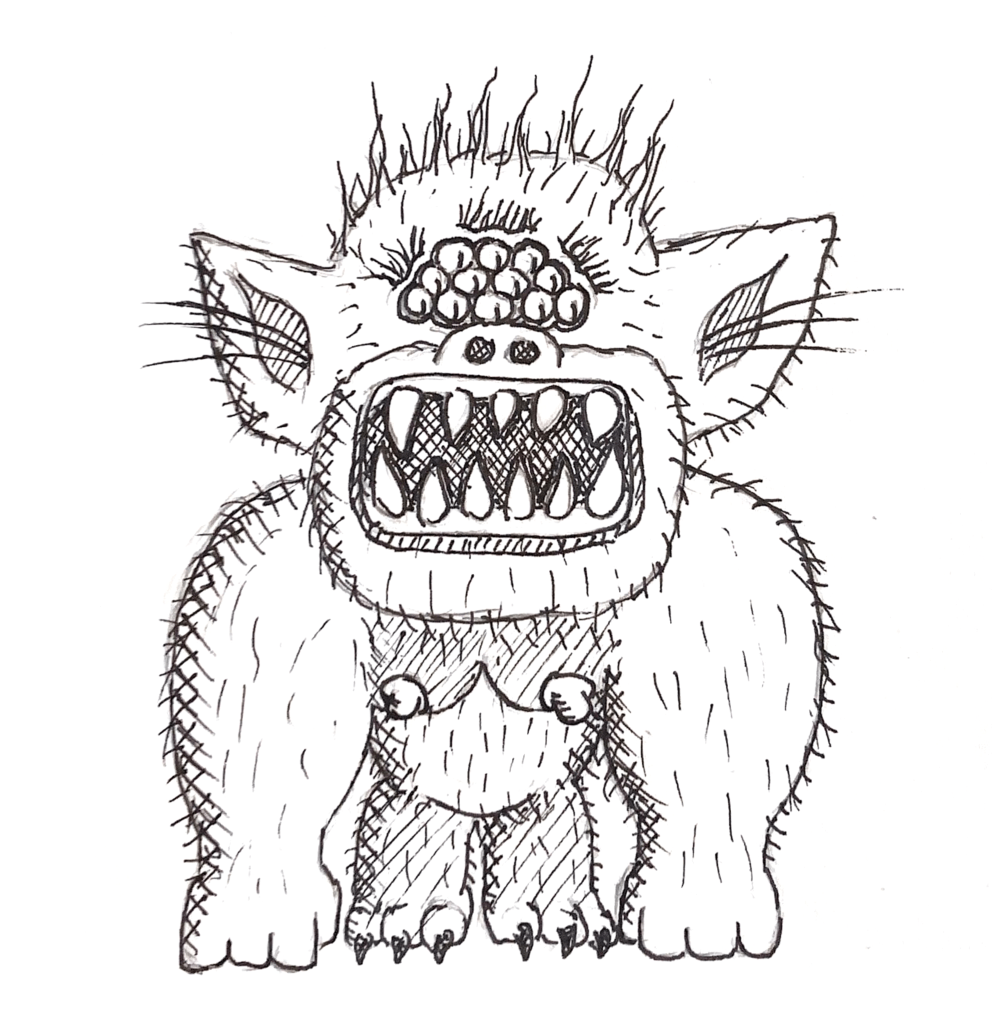
But it happened one night that a terrible beast arrived in Gerving and devoured all the crops. Those who saw it gave conflicting descriptions, for none dared draw nearer than the windows of their homes. Some said it had two legs, and walked upright; while others insisted it had four, and loped about thereon. But it was generally agreed that the beast was larger than any natha, muscular, and covered in fur, with not even one tail, which was a peculiar deficiency for a monster, they thought.
And so the next morning, after bemoaning their ruined harvest and the possibility of starvation, a group of natha climbed the great Mountain Plap, atop which lived their ruler Kak in his majestic mansion.
When they knocked on his door they heard a disconcerting crash and a wrathful howl from within. Then Kak appeared at his window and said, “Why have you mere natha disturbed your ruler? This interruption has ruined the model village I have been building for three months, for your knocking startled me and caused my hand to slip. Answer for your crimes!”
Then the natha all looked at each other and shifted their feet and wrung their hands, for none among them wished to bear the responsibility of speaking to Kak. But then Kak howled again, and the natha who was called Reet said, “Forgive us, ruler. We have come to tell you of a beast which has destroyed all our food.”
“A monster! In my domain? This I doubt very much.”
“But I saw it,” said Reet.
“I would know about a monster in my domain,” said Kak. “As for your food, it seems you have allowed it to be destroyed, so you will have to plant it again.”
“But it will be many months before we can eat it,” said Reet.
“And a hungry few months it will be,” said Kak. “Now leave. My model village awaits.”
So the natha climbed back down the Mountain Plap and told the news to their families. And they planted more crops as their ruler had instructed, and for many months they starved as they awaited the harvest.
But when the harvest was nigh, the beast came again, and again it destroyed the crops. And there was terrible wailing then.
“We must tell Kak what has happened,” said one natha.
“No, for he will only blame us,” said another.
Nevertheless a group of natha again scaled the mountain and told Kak what had happened.
“I blame you,” said Kak. They had interrupted his singing hour. As a result he refused to offer any assistance.
“Someone must find this monster and slay it,” said a natha, a farmer whose name was Brusk.
“I will slay the monster,” said a little boy.
“Have you military training?” asked Brusk.
“Yes, I am a soldier in the militia,” said the boy, and so he was. His name was Kifkin.
“We should send all our soldiers against the beast,” someone said.
“No,” said Brusk, “for then the monster would run away. We must give it the impression that it can win the fight.”
“Then Kifkin shall attack first while the militia stealthily surrounds it, and we shall attack when it is occupied with the boy,” said a soldier.
“So it shall be,” said Brusk.
But first they had to plant their crops and starve through another season.
Then the beast came again, and Kifkin approached it as planned, and the other soldiers waited behind trees and bushes. And bold Kifkin said unto the monster, “Ho! I challenge you to a battle, vile creature, for you have taken our food.” And he raised his sword high so that it glinted in the moonlight, and all who saw him were in awe of his bravery.
The beast, in turn, let out a great grunt and lumbered toward Kifkin on all fours, and then it grabbed him with a mighty arm, and it tore him into so many pieces that it would give you a headache to contemplate, and bold Kifkin thereafter knew no pleasures nor pains.
Many of the waiting soldiers fled in terror, and many others remained in hiding, so that the few who did advance upon the beast were quickly dealt a fate similar to poor Kifkin’s.
After that tragedy the Gervingers fell to despair. It seemed they had no way to destroy the creature, and their ruler was ambivalent to their situation.
But it happened that around this time a very brave and powerful adventurer was wandering outside Gerving. She entered that domain with a shovel which had seen many battles and dug many holes. And the Gervingers saw that one of her feet was wooden. So the Gervingers asked who she was, and she said, “I am Kanky-dip of the Desolation. I seek a place to rest and eat, for I am weary from adventuring.”
The Gervingers said, “As for food, we cannot help you, for we are all starving. But you may rest in Kifkin’s home; there is an empty bed there.” And so Kanky-dip gratefully accepted the Gervingers’ hospitality.
It will not surprise you that the Gervingers were exceedingly interested in Kanky-dip’s skills as an adventurer. A council gathered to discuss her arrival, and they agreed that she should battle the beast in exchange for a home in Gerving. But first they had to replant their ruined crops.
Kanky-dip had difficulty adjusting to life among the Gervingers, for they held strange rituals and spoke of odd things. She found that her life of adventuring gave her no experience to which the Gervingers could relate, and they consequently felt she was a bizarre person. But when they started planting crops Kanky-dip saw an opportunity to endear herself to them by engaging in their lifestyle, so she asked the natha she lived with to teach her to garden.
That natha was named Ligma, and she taught Kanky-dip with eagerness and passion. For Ligma had taught the late Kifkin to garden in years past, and teaching Kanky-dip felt as though she were keeping Kifkin alive in spirit. Kanky-dip learned slowly, for her accumulated experiences consisted mostly of destroying life, not creating it; and even before her adventures she had lived in the rocky land of Tuubuut, where no one gardens and few things grow. But she was a diligent student, and despite her clumsiness and tendencies to crush stems and spill seeds, she was not discouraged. To her this was a new sort of adventure, and she undertook it with the same pride and dedication she would with any adventure– or perhaps more. And Ligma saw this and smiled through the missteps. The two natha thereby grew a respectable garden.
Now Kanky-dip was glad to have found a mentor and friend in Ligma. But as harvest season approached the council came to Kanky-dip and said, “Kanky-dip, you call yourself an adventurer. Have you slain monsters?”
“Yes, I have slain several,” said Kanky-dip, as indeed she had.
“There is a monster which haunts Gerving,” said the council. “Since we have graciously housed you, we ask that you slay this beast, for it destroys our food each harvest. Then you shall continue to live among us and enjoy the food we have grown. For though you are surely hungry, you are not nearly so hungry as us.” And Kanky-dip had so recently found acceptance that she dared not risk it by denying the Gervingers, so she agreed to fight the monster.
The monster appeared just before harvest, as they knew it would. But this time Kanky-dip was there with her shovel, ready to defend the land they had cultivated. The beast approached in its lumbering gait, and Kanky-dip saw the powerful muscles of its forearms, and the dark fur all over its body, and the multitudinous eyes bunched over its forehead gleaming yellow in the starlight. But she was not afraid, as she had battled monsters before. Yet in this particular battle she suffered one disadvantage: one of her feet was missing and replaced by a wooden prosthesis, for she had recently lost that foot to the terrible Kcheevitz of Vorgoftonk.
So when the monster drew near, Kanky-dip held her shovel ready and said, “Come no closer, for this food is not yours.” But the creature did not heed, and instead struck her such a blow that an ordinary natha would have been sent hurtling through the air. But Kanky-dip’s strength was extraordinary, and she parried the blow with her shovel, and the metallic impact rang loud and clear in the night sky, and all who heard drew courage from it, except the monster, who howled in pain and rage.
Then it leapt into the air toward Kanky-dip, and its shadow engulfed her utterly. Kanky-dip dashed out of the way, but she was unsteady on her fake foot, and fell to the ground. And the beast landed beside her with such force that her body shook, and dirt rained down upon her.
Now Kanky-dip knew she was in mortal peril, for it is disadvantageous to do battle while lying on the ground. But as she started to stand, the beast grabbed her foot and pulled mightily, and brave Kanky-dip fell down again with an awful thud that sent her brains swimming. And then the beast pulled her toward itself, and all the Gervingers turned away, for they did not wish to see another natha torn to pieces. But lo, the monster suddenly released Kanky-dip, for it had grabbed her wooden foot, which with a loud popping sound dislodged; and the monster fell backwards with only the prosthesis in its hand.
Then Kanky-dip stood with astounding success, and limping toward the fallen beast with amazing speed she gave a great battle-cry and brought her shovel down hard upon its head; and that buffet was so great that the monster’s brains swam, and for all of its eyes it could see nothing but blurs. Then Kanky-dip struck it again on its hand, so that it dropped her wooden foot. And the thing scampered away so quickly that Kanky-dip could not overtake it, even after she had reattached her foot.
For a while Kanky-dip chased the beast by following its monstrous footprints in the grass, which took her over many hills and through many valleys, until at last she heard a strange blubbering wail, and following it she found the monster eating grass and crying between mouthfuls. And Kanky-dip felt a great pity for the creature, for grass is not a happy food. So she did not slay it then.
Instead she returned to the garden she had helped plant, and she picked as many chlotberries as she could carry. The Gervingers asked her if she had killed the monster, but she did not answer, and her face was so grave they dared not question her further.
She returned to the crying monster, and when it saw her it backed away in fear. But she deposited her chlotberries before it and said, “I will not hurt you. What is your name, noble creature?” Then the creature made a strange sound which Kanky-dip interpreted as “flumfk.”
“These berries are for you, Flumfk,” she said, and she tossed one its way. First the Flumfk eyed it with suspicion, but when it saw the kindness in her eyes it was reassured, and it ate the proffered berries with great relish, even though they were unripe and hard.
“I am sorry I hurt you,” said Kanky-dip, “but if you keep eating all the Gervingers’ food they will continue to starve. Therefore steal from their farms no more, but wait for me each harvest season and I shall bring you the food I have planted.” Of course the monster did not understand her words, but it did understand her kindness, and that speaks more clearly than any words can.
So the monster finished the berries and gave Kanky-dip an affectionate brush on her short hair, and Kanky-dip was not afraid, for they had reached an understanding, and also its hand was too injured to hurt her. Then it retreated to its hideout in the Desolation outside Gerving.
When Kanky-dip returned to the village she cried, “The monster shall trouble you no more.” And all of Gerving cheered so loudly the very leaves shook. Then Kanky-dip was declared a hero of the domain, and it was decreed that she no longer be known as Kanky-dip of the Desolation, but rather Kanky-dip of Gerving. And Ligma was so proud of her protege that she shed a single tear.
That season the Gervingers ate passing well, and they served a feast in Kanky-dip’s honor. “I have not eaten in years,” said one natha. And indeed he had not. So you can imagine their elation as they dined upon the vogmelon and buppercake and trinniroots and logimpods and dipnuts and rainaplips and shimsherraraghs and pippich and gerdied gongos and slimped darps. Kanky-dip had never eaten any of these foods, and she delighted in all of them except the rainaplips, which she deemed too sweet. She was originally a Tuubuutite, you remember, so her misjudgment in this matter may be forgiven.
After the feast Kanky-dip returned to her gardening with even greater vigor than before, and Ligma smiled to watch her. Kanky-dip planted the most expansive garden Gerving had ever seen, to the extent that one natha asked her how she planned to keep all that food from going to waste. “I have developed a hearty appetite,” she said, and the Gervingers applauded her wit. Now you may say that this was not a particularly witty comment, but you must understand that the Gervingers were not a particularly witty people.
As promised, Kanky-dip delivered her food each season to the Flumfk. When someone asked her where she was taking her cartful of produce, she said, “It is a gift for friends I met on previous adventures.” And no one questioned this.
She found the Flumfk each season at that tree by which she had seen it weep, and there it accepted the food she brought. It grabbed it in hulking handfuls and chewed loudly while looking with all its yellow eyes at Kanky-dip, a habit which she at first found disconcerting, but which she later attributed to the beast’s affinity for her, and which she therefore learned to appreciate and even enjoy.
Yet as the seasons passed the Flumfk ate its food more and more quickly, and developed a habit of staring expectantly at Kanky-dip when it had finished eating; and at these times Kanky-dip could only say, “That is all the food I grew.” And though she expanded her garden each subsequent season to yield more food, still the Flumfk was not sated.
“You will have to supplement these meals with food from other domains,” Kanky-dip told it one day, “for already I have sacrificed my own portions in large part to you, yet you are not satisfied.” She did not realize that the Flumfk already did scavenge other domains for food when it was not at Gerving. And now the Flumfk wept in its blubbering way. But Kanky-dip only said, “I am hungrier than you, so be content. I shall see you next season, and then I shall have pluntips and gurtroots and the other fibrous vegetables this weather yields.” And with those words she left the beast to its crying.
That night, as Kanky-dip lay in Kifkin’s former bed listening to her stomach twist about itself, she heard a strange sound outside, as though a great beast were trampling about. Then she knew that the Flumfk had returned to wreak havoc upon Gerving as it had done in years past. She leapt up from bed, and wearing only her pajamas and carrying only her shovel, she dashed outside to confront the creature.
She saw it tearing apart a neighbor’s field, and she shouted unto it, “Flumfk, begone!” But though the beast looked at her for a moment, it quickly returned its attention to the field it was terrorizing. Kanky-dip shouted at it again, and again received no acknowledgment.
By now the natha had begun to watch from their windows, and they whispered amongst themselves.
“The monster has returned to life,” said one.
“No, it must be another monster,” said another.
“Not, it is the same one, for it never truly died,” said a third. And though she was correct, no one believed her at the time.
Now Kanky-dip raised her shovel up in a threatening way, and waved it terrifically in the Flumfk’s face. Then the beast abandoned the vegetables, but instead lumbered over to another field and ate from it instead. So Kanky-dip chased it from that field as well, and then from a garden, and then from another field, and all the Gervingers watched this pajama-clad hero run all about Gerving waving a shovel and chasing the Flumfk, and it was a sight they all remembered for the rest of their lives.
But eventually the Flumfk realized that for all her shouting and shovel-waving, Kanky-dip would not actually harm it. And then it ignored her, and ate from the fields as though she were not there.
“Kill the beast!” shouted one Gervinger who had dared to open his door and observe from the entryway.
“Yes, enough of this! Kill it!” shouted another from her window, for she was not so brave.
But Kanky-dip had developed a bond with the beast, and though its insolence hurt her, she could not bear to hurt it. And so at length she relented and merely sat dejected upon the ground as the Flumfk devoured the fields around her. And for all the furious shouting of the Gervingers, she did not move. And all the crops were destroyed that night.
When the Flumfk had finally lumbered out of Gerving, the natha all gathered around Kanky-dip in anger. “You have allowed the monster to destroy our food,” they said.
“And you lied to us about killing it before,” said another. And this time they did believe her.
“It is true,” said Kanky-dip. And though they questioned her, she would not explain herself.
“For you to repay our hospitality in this manner is a grievous offense,” said one natha. “I declare that Kanky-dip ought to be exiled.” And all the Gervingers agreed, and they all said so. And Kanky-dip did not protest.
Now you no doubt know that Gervingers had no right to exile anyone: only their ruler Kak wielded that power. But Kanky-dip was unfamiliar with Gerving law, and nobody explained this technicality to her; and she would not have pursued the matter even if somebody had. So she left Gerving in disgrace.
But before she left, she visited Ligma once more, and said, “Dear Ligma, I ask that you grant me a bag of seeds, that I may cultivate a garden wherever I go.” And though Ligma was upset that Kanky-dip had allowed the beast to destroy her garden, she still loved Kanky-dip for her passion. And Ligma gave Kanky-dip a bag of seeds.
“I hope to repay you some day,” said Kanky-dip. But she never did, for when she finally returned to Gerving in later years, Ligma was dead.
But now Kanky-dip ventured back into the Desolation she had so recently escaped, armed only with a shovel and a bag of seeds. She tried to plant a garden in the Desolation, but no garden grew, for nothing grows in the Desolation. So she sought another domain where she might live, but this was no easy task, for Kanky-dip had been exiled from almost every domain in the world for her various mistakes. But she eventually came to Vorgoftonk, and she was not turned away at those gates alight with blue flame.
Now you may think that Kanky-dip had no success here, for Vorgoftonk is a bleak domain with little vegetation. But this is not due to any infertility of the land there. Rather it is a symptom of Vaka’s aesthetic sensibilities, for the ruler of Vorgoftonk cares little for plants, and instead prefers growths of flesh and bone. And though Kanky-dip made no friends amongst the spooky folk there, she did find a patch of land undesired by anyone else, for it was not particularly horrible, and therefore unworthy of any dignified Vorgof’s attention. But Kanky-dip made it her home. She dug herself a little subterranean dwelling where she could sleep and be alone, and above it she planted Ligma’s seeds. And though the Vorgofs thought her strange for burying tiny objects in the ground, they did not stop her.
As the months wore on Kanky-dip’s underground home expanded. She created a room for exercise, and a room for sleeping, and a room for talking to herself, and a room for entertaining guests; although this last room she created mostly as a morbid joke, for she had no friends. But she did have vegetables. These grew bright and colorful in the Vorgoftonk gloom, and changed with each season as Kanky-dip planted the appropriate seeds. Had she been in another domain she might have distributed her food amongst her neighbors, but the few Vorgofs whom she coaxed into trying her vegetables dismissed them as too pleasant-tasting. Yet this did not upset Kanky-dip, for to her they tasted wonderful, and anyway she drew her primary satisfaction not from eating but from cultivating the garden. “Like a Borgokog, I have created life,” she said; and so she had, in an admittedly inferior manner which is nevertheless the closest natha can attain. And there in gloomy Vorgoftonk, surrounded by horrors, and exiled from all domains she had otherwise entered, Kanky-dip with her garden was happy.
 Gibbering Taylor
Leave a comment